Challenging Bike Routes in Portugal – For Experienced Cyclists Seeking More
Written by Sérgio Marques, Founder & Route Designer, Top Bike Tours Portugal
June 8, 2026
1091 words
5 minutes
For experienced cyclists, Portugal offers far more than relaxed coastal routes. Beyond the easygoing Atlantic paths, the country’s interior reveals a very different cycling landscape. One defined by climbs, heat, distance, and endurance.
To understand how these demanding routes compare with other levels, it helps to read the full ** ** Cycling Portugal Difficulty Guide which breaks down easy, moderate, and challenging options across the country.
What Makes a Route Challenging?
In Portugal, cycling difficulty is rarely about technical terrain. Instead, it is driven by a combination of elevation, distance, and environmental conditions.
Challenging routes typically include:
- Long or steep climbs, often repeated throughout the day
- Daily distances of 75–100+ km
- Continuous gradients, especially inland
- Accumulated fatigue over multiple days
- Exposure to heat, especially in summer months
These are routes designed for cyclists who are comfortable pacing themselves, managing effort, and riding consistently over long distances.
Most Challenging Cycling Routes in Portugal
While Portugal is often associated with moderate cycling, there are several routes that clearly stand out for their physical intensity.
Douro Valley - Demanding but Rewarding
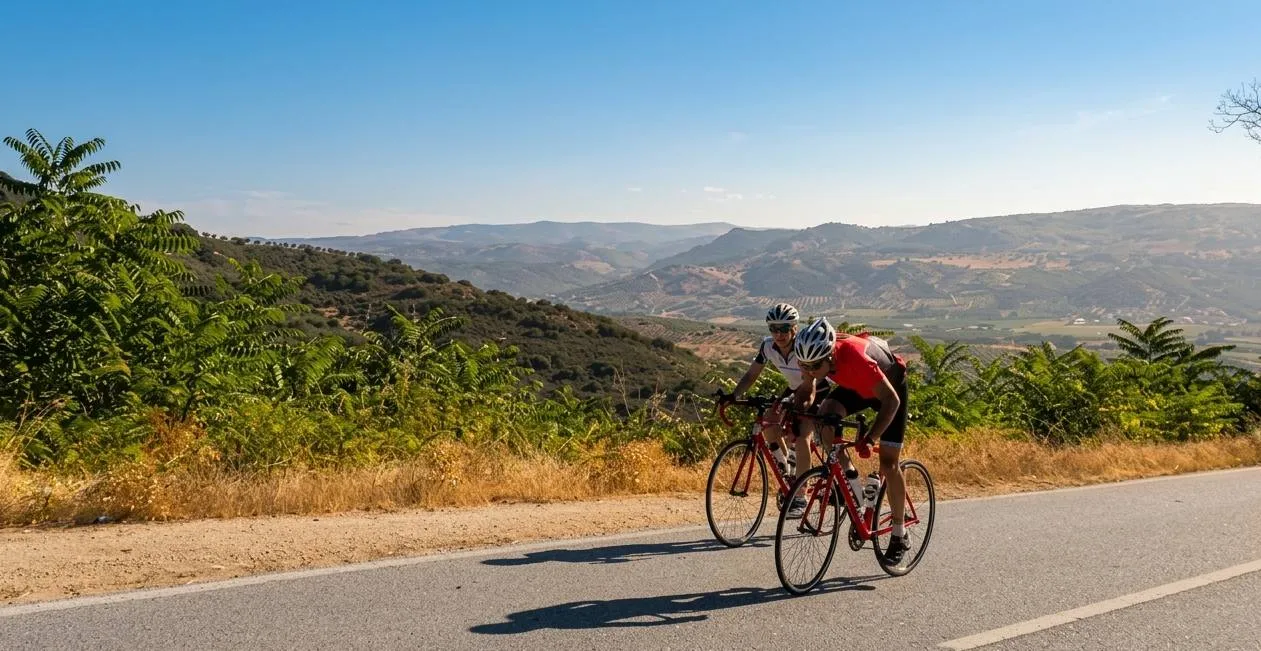
The Douro Valley is one of the most spectacular cycling regions in Portugal, and also one of the most physically demanding.
- Short but steep climbs between vineyards
- Constant elevation gain throughout the day
- Heat that intensifies the effort in warmer months
- Dramatic landscapes that reward every climb
You can explore this experience in more detail through the Douro Valley wine cycling tour which is considered one of the most challenging cycling holidays in the country.
Extended Camino de Santiago Routes
Long-distance cycling routes can also become challenging, not necessarily because of extreme gradients, but due to their duration and cumulative physical demand.
The French Way to Santiago bike tour is a good example.
- Long journey across multiple regions
- Consecutive days on the bike with limited recovery time
- Requires endurance, pacing, and mental resilience
Interestingly, this route can also appear in the moderate category depending on how it is structured (daily distances, support, and pacing). This overlap highlights an important idea: difficulty is not fixed; it depends on how the tour is designed and how you choose to ride it.
Who Should Choose Challenging Routes?
Challenging cycling tours are best suited for:
- Regular or experienced cyclists
- Riders who are comfortable climbing and managing effort
- Travellers looking for a physically demanding experience
- Those who prioritise challenge over comfort
These routes are not about speed or performance metrics. They are about endurance, consistency, and the satisfaction of overcoming effort.
How to Make Challenging Routes More Accessible
Even the most demanding routes in Portugal can be adapted to suit different levels of fitness and confidence.
Here are some practical ways to make them more manageable:
- Choose shorter daily stages
- Travel outside peak summer heat (spring or autumn)
- Build in rest days when possible
- Ride at your own pace rather than following strict schedules
- Consider electric assistance
For many travellers, using an e-bike transforms a challenging route into a much more enjoyable and achievable experience.
Final Thoughts
Challenging cycling routes in Portugal are not about speed or competition, they are about perspective.
The climbs are longer. The days are harder. The effort is real. But so are the rewards. From the terraced vineyards of the Douro to the long journey towards Santiago, these routes offer something deeper than a typical cycling holiday, a sense of achievement that stays with you long after the ride is over.
FAQs - Challenging Bike Routes in Portugal
1. What are the most challenging bike routes in Portugal?
Some of the most challenging cycling routes in Portugal include the Douro Valley, with its steep vineyard climbs, and long-distance routes like the Camino de Santiago. These routes combine elevation, distance, and heat, making them ideal for experienced cyclists seeking a physically demanding challenge.
2. Is the Douro Valley difficult for cycling?
Yes, the Douro Valley is considered one of Portugal’s most demanding cycling regions. While distances may not always be extreme, the constant short and steep climbs, combined with high temperatures in summer, make it a physically intense experience.
3. How hard is cycling the Camino de Santiago in Portugal?
Cycling the Camino in Portugal can range from moderate to challenging depending on the route design. Longer itineraries with consecutive riding days and extended distances increase the difficulty due to accumulated fatigue and endurance requirements.
4. What makes a cycling route challenging in Portugal?
Cycling difficulty in Portugal typically comes from elevation gain, long daily distances (75–100+ km), sustained climbs, and heat exposure. Unlike technical terrain, the challenge is more about endurance and consistent effort over multiple days.
5. What is the best time of year for challenging cycling routes in Portugal?
Spring (March–May) and autumn (September–October) are the best seasons. These months offer milder temperatures, making long climbs and multi-day rides more manageable compared to the intense summer heat.
6. Are challenging cycling routes in Portugal suitable for amateur cyclists?
Challenging routes are best suited for experienced or regularly active cyclists. However, they can become more accessible with proper pacing, shorter stages, and support options such as luggage transfers or e-bikes.
7. Can I do demanding bike tours in Portugal with an e-bike?
Yes, e-bikes are a great way to enjoy Portugal’s most challenging routes. Electric assistance reduces the impact of steep climbs and long distances, allowing more cyclists to experience demanding regions like the Douro Valley comfortably.
8. How long are daily distances on difficult cycling tours in Portugal?
On challenging tours, daily distances usually range from 75 km to over 100 km. Combined with elevation gain, these distances require good fitness, endurance, and energy management.
9. Is cycling in inland Portugal harder than coastal routes?
Yes, inland regions such as the Douro Valley or Alentejo tend to be more physically demanding due to continuous climbs, higher temperatures, and less flat terrain compared to the relatively easier coastal routes.
10. How can I prepare for a challenging cycling tour in Portugal?
Preparation should include regular endurance training, climbing practice, and adapting to long consecutive riding days. Planning for hydration, pacing, and rest is essential, especially when riding in warmer conditions.
11. Are there guided options for difficult cycling routes in Portugal?
Yes, many challenging routes are available as guided or self-guided tours. These often include route planning, accommodation, luggage transfers, and support, making demanding rides more manageable and enjoyable.
12. Is heat a major factor in cycling difficulty in Portugal?
Yes, especially in summer, heat significantly increases the difficulty of cycling inland routes. Managing hydration, starting rides early, and avoiding peak temperatures are key strategies for safe and enjoyable riding.